Interview with JellyBeanHQ

Tags

Meet the lovely Anastasia Bird, owner of JellyBean Etsy shop. I was lucky enough to be paired up with Ana for the Etsy School which was run during February. Ana and I both learned a lot from each other, and about ourselves and our shop, through the four weeks of Etsy School. The final week of Etsy School was all about social media and getting your Etsy shop “out there” so we thought what better way than to interview each other on our blogs!?

Anastasia, the owner of JellyBeanHQ

1. Tell us a little bit about your business and what you make?

I create handmade wooden home decor and gifts, they’re all completely able to be personalised to suit the customer. We create everything from plaques, to freestanding decorations, to stationery sets.

2. What made you want to work with wood? How did that come about?

I’ve always been creative and have a lot of crafty hobbies, such as cross stitch, crochet and card making… However I really have a passion for wood. It’s so versatile and is essentially a blank canvas. I really feel that wood is a great material to work with 🙂

3. What inspired you to start your own business?

I used to be a carer for the elderly but sadly had to stop due to injury. I struggled with not working whilst recovering and had to find an output to stop me being so bored and feeling useless. So I got creative and Jellybean was born. The inspiration I suppose was making the most of myself… not allowing myself to just sit and be… I wanted to be something!

4. What dreams do you have for the business? What would you absolutely love to see happen?

Eventually I’d love to have a shop, with a workshop in the back. The shop would have a lovely little cafe and be full of gorgeous handmade items from fellow small business’. Sort of a one stop shop for all gifts, home decor and craft supplies… That’s a long long way in the future but it’s a big dream as it’d be awesome to give back to the community and create jobs. In the short term i’d just love to keep learning, building my portfolio and growing the business at a steady rate.

5. What’s your favourite thing about running a business?

The customers, 100%. I “meet” so many people and from all different walks of life and it’s so interesting! I’ve made some friends for life through Jellybean and I could not be more thankful!

6. What do you feel is the most challenging part about running a business?

Absolutely has to be finding the right balance between home and work… Jellybean is my full time job and I find it really challenging to switch off sometimes. But it’s definately something I’m improving all the time and the business is better off as a result.

7. What part of running your business do you always strive to improve?

My photography. My photos, to me, are never good enough. I’m always learning new things and ways to make my photos the best they can possibly be. It’s so important as a predominately e-commerce business as the photos really need to make the customer know what the product is all about. They can’t touch it, or see it in person until they’ve bought it so it’s really really important we get that right.

8. Do you have a favourite small business other than your own

I have tonnes and tonnes of favourite small business’… Heartstitch, Patricks Pieces, Sew Now, Poppy Rose Embroidery, Playdough Factory… The list can go on and on and on!

10. Whats your inspiration

My customers, my animals, music, colours, trends… Anything and everything can inspire me!

You can find JellyBean on Facebook here, on Twitter here and of course on Etsy here.

Cottoning on

Tags

,

I asked the lovely (and now famous – check out her pretty flower brooch pattern in the Spring supplement of Simply Crochet Issue 16!) Rachel to knit a little something with Vinni’s Colours Nikkim and tell us about her experience. I really, really, really like her knitted washcloths! So much that I think I may just knit up a couple of yarn swatches for each of the yarn shades. Yes. I said it. Knit. And yes, I do own a pair of knitting needles and I can knit. Now you know my Deep Dark Secret.

At the bottom of Rachel’s review is a 10% discount code to use in my Etsy shop. You know you want to…

Thanks again Rachel for your great review and giving us your honest opinion and congratulations again on the great achievement of being a Published Crochet Pattern Writer.

Read Rachel’s review here: http://thelittleroomofrachell.wordpress.com/2014/03/04/cottoning-on-2/


Book giveaway

Tags

By now you would have read my reviews on the Yarn Works and Spinning & Dyeing Yarn books. Did my feeble attempts to dye cotton inspire you to also dye your own yarn? Want to give it a go?

Here’s your chance!

Spinning and Dyeing yarn giveaway

Just visit my Facebook Page, like the page and tell me what colour you would dye your yarn. I will draw the winner randomly. If you are the lucky winner you can tell me which of the two books I should send to you.

Good luck everyone!

Terrific Tuesday

Tags

, , ,

On a Monday I can still remember the fun I had over the weekend, Wednesday is the middle of the work week, on Thursday I start getting hopeful and on a Friday I can taste the weekend. But what about a Tuesday? It’s so…. just there. Weekend memories are too far away and the upcoming weekend might as well be a year away.

What we need is a bit of colourful inspiration to get us going on a Tuesday, don’t you think? A pretty picture, beautiful scenery or colourful imagery. Yup, that’ll liven up Tuesdays and turn it into a terrific day!

From now on I will go through my photos and Pinterest likes every Tuesday and find us a pretty picture to add colour and joy to the day.

xxxxxx

See how happy she is? Having yarn on the brain is good.

Wishing you all a Terrific Tuesday

Natasja

Book review – Yarn Works

Tags

As I explained in my earlier post, I was lucky enough to receive two books on spinning and dyeing your own yarn to review. These books have given me a glimpse into the world of the hand spinner and hand dyer. It’s a very interesting world and it’s hard work! I have a lot of respect for indie dyers and spinners and can totally understand why their yarns are more expensive than yarns produced in a factory.

This post is my review of Yarn Works by W J Johnson (a spinner and dyer for more than 30 years). The book is available in soft cover on Amazon for £20.

Yarn Works takes you from fibre source, to dying, to spinning and even on to knitted projects using your truly individual yarn. Through a series of workshops: Fibre Workshop, Spin Workshop, Dye Workshop and Knit Workshop W. J. Johnson brings you full circle. She shows you how to spin and dye the yarn and then provides knitting patterns that use that particular spun and dyed fibre. Even if you don’t want to spin or dye your own yarn, you will enjoy learning about fibres and yarn types with the interesting “history behind” sections.

The book is written in a relaxed style that makes you feel the writer is right there with you in the room, giving you handy tips and guiding you through all the steps. With little side notes like “Don’t sweat the details. Now that you know the different spin methods, I’ll tell you the honest truth. Spinners do their own thing sometimes.” She makes you feel at ease and makes reading the book very enjoyable.

But don’t think the whole book is informal and chatty. No way. It’s very, very, precise, even scientific in its instructions. Whereas I felt that Spinning & Dyeing Yarn was not giving me enough specifics, this one sometimes intimidated  me with all the measurements and maths involved. Each of the Workshops have Appendices with even more information. For example, the Dye Workshop Appendices include guides for mixing custom dye colours, and mathematical formulas to calculate dye quantity from stock solutions. It’s full on and intense. To give you an idea of how thorough the instructions are, in Spinning & Dyeing Yarn there were five steps to dye cotton yarn. In Yarn Works there are 11 and some of those steps refer you to the Appendices as well.

For my review of Yarn Works I followed the Dyeing by Osmosis technique on page 109.

I bought a 100g ball of undyed cotton from Texere Yarns, 25g powered dye called Procion MX in Lime Chartreuse from Woolwing on eBay , 100g soda ash from Intralabs on eBay and Dylon salt from Robert Dyas.

Step 1 says to wet the fibre. Nowhere does the instructions say to wet with Soda Ash, but I knew this had to be done from reading the instructions on the Proxion MX packet. For my 100 g of cotton, I filled a bowl with 2 liters of water and added 10g of soda ash. I soaked it for 10 minutes and squeezed out the excess.

Step 2 is to mix the dye solution. Again I followed the instructions on the Proxion MX packet.

To get two different shades, I added 5 g of dye powder to the dye stock which I had decanted into a glass jar, thereby creating two different shades of green. Just for luck, I added a bit of water to the dye stock in the bowl to water it down a bit more.

Step 3 tell you to place one end of the wet fibre into one jar and drape the rest of the undyed fibre in the other. It says to let the fibre soak up the dye until it’s 2.5 cm apart.

Step 3 continues to say to lay the fibre on cling film and allow the colours to move closer together. I actually like the big section of undyed yarn so I left it as it. If I had used two different shades, for instances red and yellow, I would have liked to get them to “meet” so that it would create orange, but for me, the two shades of green with undyed cotton in the middle looked really good.

Step 4 is to “finish the fibre accruing to dye cooking method”. I wasn’t applying heat to mine so I assumed that would mean just leaving it over night like the instructions in Spinning and Dyeing Yarn said. I also wrapped it in cling film to keep it from drying out.

Sunday morning it was time for the big reveal. I rinsed off the excess dye under cold water and let the yarn dry on a drying rack.

I’m very happy with the result. The yarn has obviously absorbed a lot more of the dye than it did for the tie dye technique and created a true lime chartreuse colour that I love.

I enjoyed using the osmosis technique from the Dye Workshop in Yarn Works. I think this book is so incredibly detailed and scientific in its approach to dyeing, that it would be of great help to anyone trying to set up a yarn dyeing business – you don’t have to rely on luck to get the perfect shade. With Yarn Works there’s a proven scientific method of getting the same shade every time. If that home dyer is a knitter as well, you would have struck gold with this book.

The focus on this books seems to me to be on dyeing, whereas Spinning & Dyeing Yarn was more focused on spinning.

I found the book very interesting and easy to read, except for the Appendices – but that’s probably why they are done as Appendices. If you need to know formulas and the science bit, you will look at the Appendices, if not, just enjoy the book for what it is: a good guide taking you through the whole process from choosing fibre, to knitted item.

*The book was sent to me by the publisher. I did not receive payment for doing the review. The opinions in this review are my own. There are affiliate links in this post, which help me run my blog.

Book review – Spinning and Dyeing Yarn by Ashley Martineau

Tags

As crocheters we use yarn every day, but do we really know what goes into getting the yarn that lovely shade of blue, or turning a sheep’s fleece into wool? I certainly don’t. That all changed when I received two books on dyeing and spinning your own yarn to review. Reading these books showed me just how ignorant and uninformed I’ve been about the most important tool of my trade.

I’ll be reviewing the books in two separate blog posts. This post is my review of Spinning & Dyeing Yarn – The Home Spinner’s Guide To Creating Traditional & Art Yarns by Ashley Martineau (a self-taught yarn spinner based in Boston, USA)

The book is available in hard cover on Amazon for ÂŁ25.

Ashley Martineau teaches you how to identify fibre, prepare the fibres, various dying techniques for both plant and animal fibres, spinning techniques and how to best photograph your hand spun and hand dyed yarn for selling online. There’s even instructions for how to build your own spinning wheel using PVC pipes.

Spinners use words like hackles, niddy noddy, drum carder, neps and they say stuff like “roving has been carded”, “skirt your fibre before washing”, “hackles are used for blending fibre and dizzying into roving”.  It’s like a whole different language. However you soon get the hang of the lingo with Spinning & Dying Yarn’s detailed explanation of what these strange words mean (it even shows you how to build one of them).

As for dying, the book covers immersion dying, gradient dying, hand painting, solar dying (not at all possible to do in the UK Winter seeing as you need 3 – 4 hours direct sunlight, but it’s a nice idea) and tie dyeing.

Everything Ashley Martineua teaches you is very clearly illustrated with excellent photographs and practical tutorials.  I decided to give one of the yarn dyeing tutorial a go.

I love working with cotton, and I sell hand dyed cotton yarn in my Etsy shop, so dyeing cotton yarn was an obvious choice for me. I bought a 100g ball of undyed cotton from Texere Yarns, 25g powered dye called Procion MX in Lime Chartreuse from Woolwing on eBay , 100g soda ash from Intralabs on eBay and Dylon salt from Robert Dyas.

I followed the instructions on page 76 for tie dying, but instead of mixing up three different colours I made up two shades of lime chartreuse which I applied with an empty Crabtree & Evelyn bodywash bottle for the all important squirt action.

Step 1 says to soak your plant fibre in a glass bowl of water with spoonful of soda ash. The only measurements are “for a large bowl a spoonful of soda ash will suffice.” At this point I remembered that the instructions that came with my Procion MX dye included a  lot of guidelines on quantities. They said to use 2 – 3 litters of water for every 100 g of yarn and then they list the exact amount in grams of Dye powder, salt and soda ash. I felt safer referring to these guidelines instead of relying on “large bowl” and “spoonful”.

Step 2 is to soak the fibre in the soda ash mixture for about 10 minutes and then squeeze out the excess, after preparing the surface with cling film. Easy enough.

Step 3 was to “mix the dye bottles following the manufacturer’s instructions.” Here it got a bit confusing because my Procion MX dye (which is, according to Google and  other home dyeing websites is probably the most commonly used brand of dye for plant fibres) instructions tell you to dissolve the soda ash in water and add this soda ash mix to your salt and water dye mix, but the book told me to do the soda ash and water step in step 1. The worrying part is that the Procion MX dye instructions specifically say that once you mix the soda ash water with the dye water, it is the start of the chemical reaction! I just hoped that my cotton yarn would still have enough soda ash mix in it to cause the chemical reaction.

To get two different shades of green, I first made up 2 liters of dye liquid according to the “mid shades” quantities given on the Procion MX instructions. I filled my squirt bottle with this and squirted the liquid randomly on the yarn. Then I added more dye power to my bottle, shook vigorously and squirted the darker colour onto the yarn. A bit of the dye powder fell onto the yarn, but I left it there just to see what would happen.

Step 4 is to “wrap the cotton in cling film”. I was a bit unsure here. Do I just bundle up my wet cotton and in a ball and wrap the cling film around it (like you would dough), or do a bring in the cling film onto the wet yarn in a rolling action so that cling film sections are in-between pieces of wet yarn? I assumed that they wanted me to wrap it in cling film in order to keep the yarn from drying out  (something I only figured out because the Proxion MX dye instructions talk about immersing the cotton in dye water for 30 minutes so I presumed it had to stay wet for the dye to take hold.) As instructed I put the wrapped cotton in a plastic bag and left it over night.

Sunday morning I went rushing to the kitchen to unwrap my cling film ball of tie dye. Luckily the green hadn’t turned red, or vanished, but it was very light. I still think it looks goods, especially the bits where I spilled the dye powder. As instructed in step 5 I rinsed it under cold water until the water ran clear and let it dry.

Here it is! My single colour tie dye cotton yarn hand dyed by me on a Saturday evening.

I will be using my yarn for a crochet project that I will blog about in a week or two. I can’t wait to see how it looks crocheted!

I’m happy with my dyed yarn, but I can’t help but think that’s due mostly to the detailed instructions of the dye powder. Combining the tie dye technique from the book with the dye powder instructions worked well for me. (I have to add here that the instructions in the book for dyeing animal fibre do give more specific measurements, but I didn’t test those techniques.)

For me this book’s strength is in showing you the artistic, creative side to spinning and dying, even more so for spinning. It teaches you what you need to know to get the basics right, but with the hope that you will take those skills and play around, be creative and make unique pieces of yarn art. At the end of each section of the book there is a gallery and artist profile. These were my favourite bits of the book.

It’s a truly inspirational book that makes you look at yarn not as a medium to crochet or knit something beautiful, but as something beautiful in its own right.

*The book was sent to me by the publisher. I did not receive payment for doing the review. The opinions in this review are my own. There are affiliate links in this post, which help me run my blog.

Facebook Page

Tags

Guess who has a Facebook Page for crocheTime again?

crocheTime facebook

I decided to start a Facebook Page again because it really is a great place for me to share quick ideas and links with you. Ditto for you to share with me. The page even has a nifty Shop tab that duplicates whatever is in my Etsy shop.

Last time I had a crocheTime Page, it reach 1,000 Likes. A lot of slip stitches have been crocheted since then, so who knows how many Likes the Page will get this time round? Here’s hoping for more than 1,000!

You can click here to Like the Page and join in the fun.

I very much look forward to seeing you there!


Terrific Tuesday

Tags

,

On a Monday I can still remember the fun I had over the weekend, Wednesday is the middle of the work week, on Thursday I start getting hopeful and on a Friday I can taste the weekend. But what about a Tuesday? It’s so…. just there. Weekend memories are too far away and the upcoming weekend might as well be a year away.
What we need is a bit of colourful inspiration to get us going on a Tuesday, don’t you think? A pretty picture, beautiful scenery or colourful imagery. Yup, that’ll liven up Tuesdays and turn it into a terrific day!

From now on I will go through my photos and Pinterest likes every Tuesday and find us a pretty picture to add colour and joy to the day.

xxxxxx

tdjakes quote passion purpose

Crochet is my passion. Crochet is my purpose.

Wishing you all a Terrific Tuesday.

Natasja

Collaborative Crochet Blanket 2014 – The Beginning

The lovely Patch has a Collaborative Blanket project going on her blog. Guess what the collaborative blanket is going to be made up of? Hexagons in any colour with a white border. Sound familiar? Of course it does! Our Crochet For Kidneys Part 2 blankets have inspired another blanket project! Will you be taking part in Patch’s blanket project? You could be the lucky winner of a collaborative hexagon blanket!

Patch's avatarmadebypatch

Ok ninjas, here we go…..drumroll please…….. The Beginning of ………

The Collaborative Crochet Blanket 2014

DSCF0691

In Stocki’s own words….
This blanket does not mind who you are,
it does not mind where you are,
it does not mind whether you are a beginner or an expert crocheter….
It is a multi-cultural, worldly-wise, love-filled blanket!
Here’s what you need to do to take part…..
 
  • Blocks MUST be made in 100% double knit (DK) cotton to make it suitable for all.
  • Blocks must be made using the appropriate hook for your yarn.
  • All blocks must be hexagons but any pattern can be used.
  • Blocks should be 15cm measured side to side
  • Blocks can be made in whatever colours you choose but please make the last round of the block white
  • Please sew all ends in!
  • Post your blocks to me… please email me to get the address (madebypatch@gmail.com)
  • Please include your name and blog address in your envelope. (You don’t have to have…

View original post 392 more words

The very last batch of your hexagons

Tags

, , ,

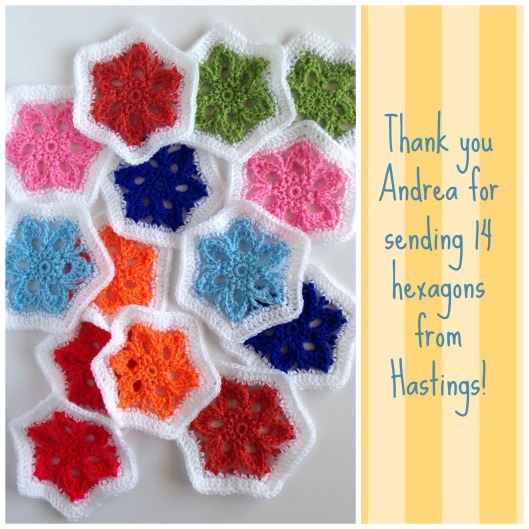
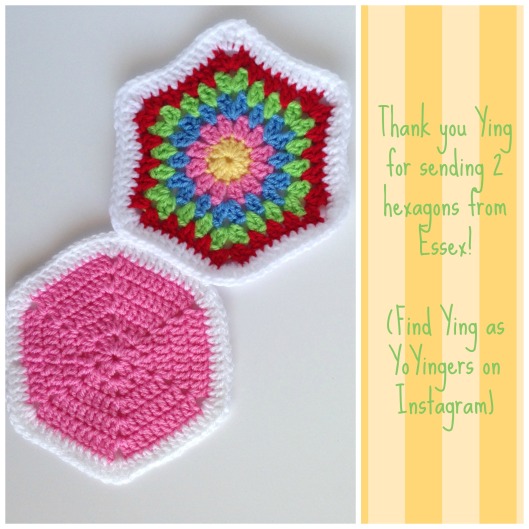
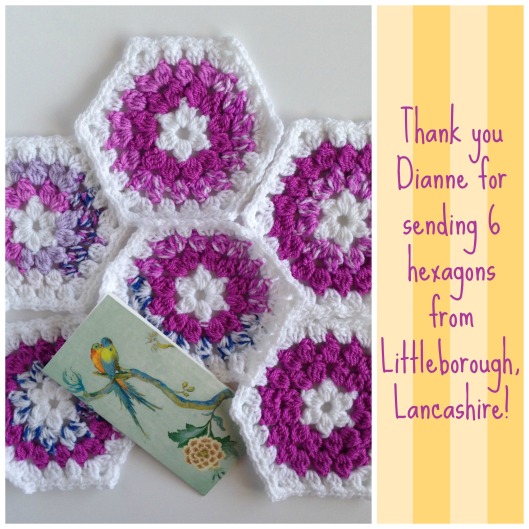
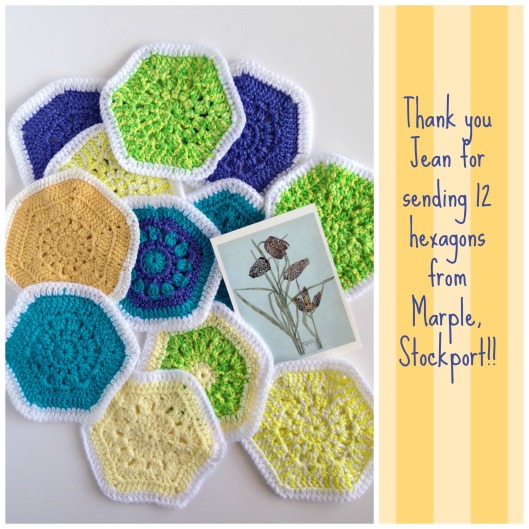
Last week I thought I had done my last “your hexagons” post, but you guys surprised me once again. I received a further 42 hexagons! These parcels were probably sent to me a day or two before the 7th of February so they arrived after the deadline. Fear not, I will use these hexagons in a blanket. In fact, between the hexagons left over from last week and this batch, we have the makings of one more colourful blanket!

collage andrea collage ying collage dianne collage lidia collage jean martin

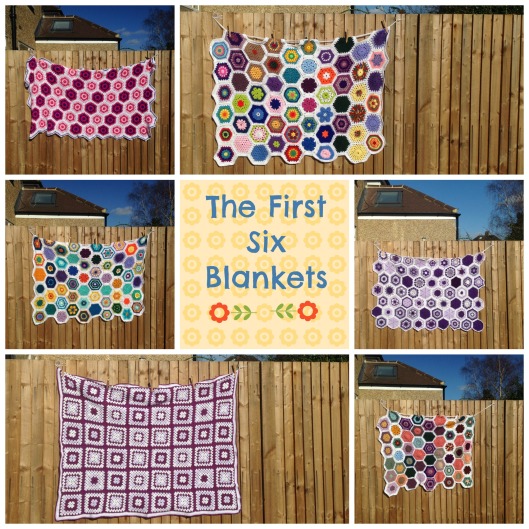
I know you’ve been wondering what our blankets look like. Wait no more! It was such a lovely sunny Winter’s day today I took the opportunity to string the six completed blankets against our back garden fence. I just couldn’t resist.

I will definitely post full size photos of each blanket when they’re all done, but for now here is a collage for you to enjoy.

First six blankets

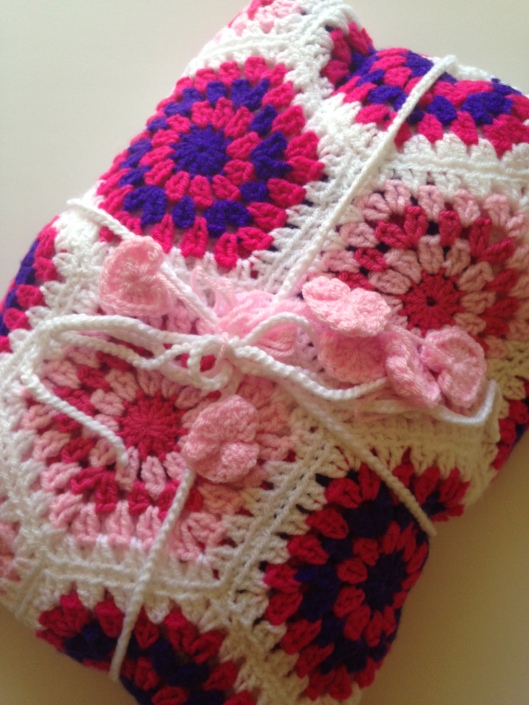
The top left hand side pink and purple blanket is the work of San Bee of Loopsan blog. Her blanket arrived beautifully wrapped with crocheted hearts and crochet tie. Isn’t it sweet? I had to undo the ties to take the photo but will retie it exactly this way to present to the patient.

IMG_5676

She even did a photo tutorial for making a hexagon – as if crocheting a whole blanket isn’t enough! Click here for her hexagon photo tutorial.

What do you think of our blankets? Do you think it will cheer up the recipients? You should see the colour combinations of the other blankets I still have to join up. They’re so, so, so pretty!

As I said last week, I don’t need any more hexagons. As it is, I’m crocheting away like a mad woman to get everything joined up before 28 February. Speaking of which, enough typing for now. I have blankets to make 🙂